
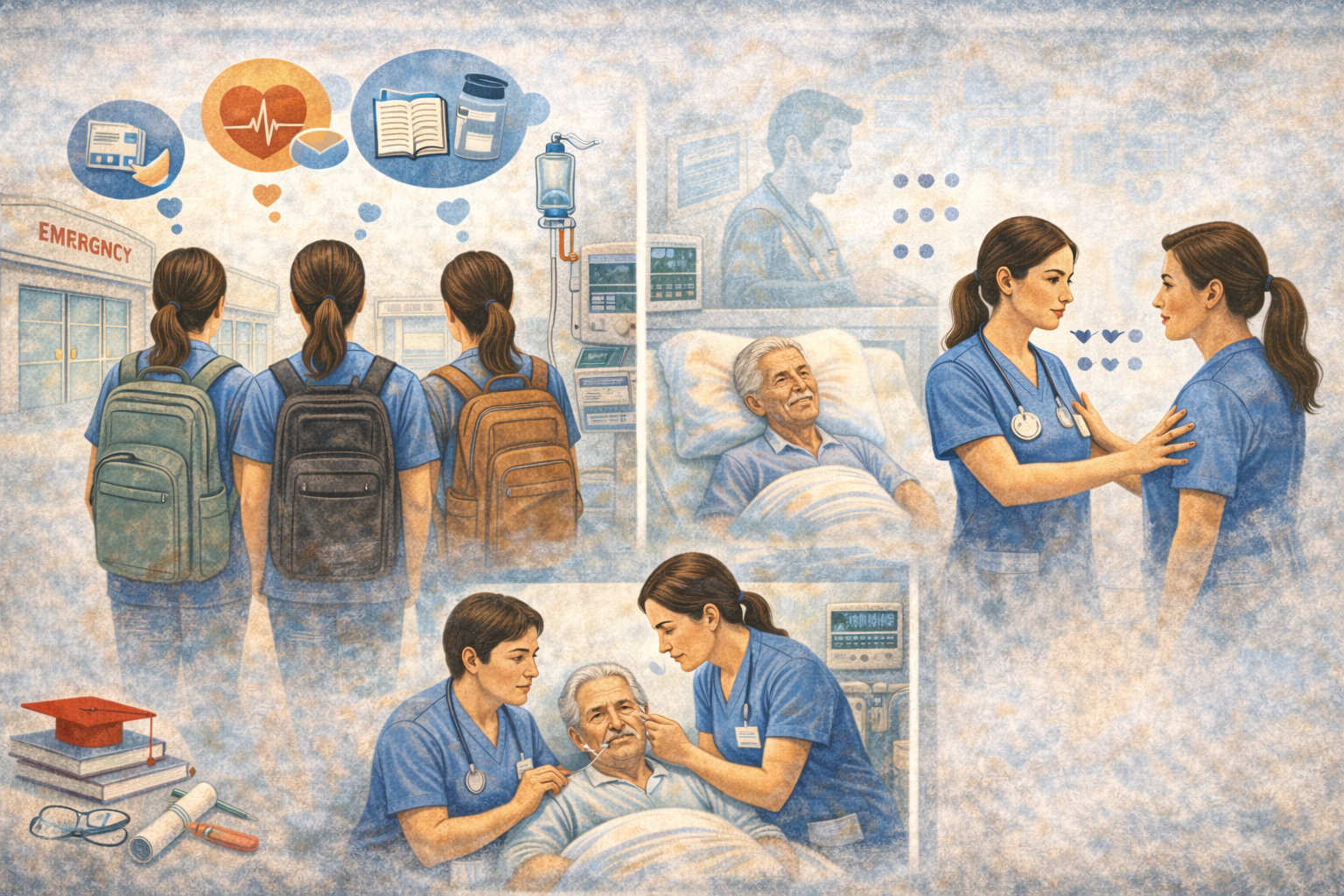
Charting the Journey: A Phenomenological Study of Novice Nurses’ Early Career Transition into Clinical Practice
 Mary Luz C. Funtecha
- Elmer G. Organia
- Jona Phie D. Montero
- Richard Deo Rox R. Alave
- Andrea Celestine C. Reyes
- Lillien A. Gonio
- Pinky Cabradilla
- Carlos O. Serra Jr.
- Angelie V. Batisla-ong
Published 2026-04-12
Keywords
- Novice Nurses,
- Newly Graduated Nurses ,
- Clinical Transition,
- Workplace Integration,
- Mentorship
- Support ...More
How to Cite
Abstract
Introduction: The transition from nursing education to professional practice is a crucial period marked by significant personal and professional adjustments. Understanding this process offers insights into the challenges, adaptations, and growth experienced by novice nurses as they begin their careers in healthcare. Objective: This study aimed to explore and describe the lived experiences of novice nurses during their transition from academic training to clinical practice, and to identify key factors affecting their early professional development. Methods: A descriptive phenomenological approach was employed. Ten registered nurses with a Bachelor of Science in Nursing and at least one year of clinical experience were selected through purposive sampling. Data were gathered via face-to-face in-depth interviews using a semi-structured interview guide. Colaizzi’s method was used to analyze the data, identifying significant meanings and themes that capture the essence of participants’ experiences. Results: Six themes emerged: Clinical and Emotional Adaptation, Workload Management, Confidence in Decision-Making, Transition to Autonomy, Handling Initial Hospital Exposure, and Integration into the Workplace. These themes collectively depict a complex transition process characterized by emotional vulnerability, heavy workload, and the gradual development of confidence and independence. Participants’ experiences highlighted the interaction between individual coping strategies and workplace factors, emphasizing how mentorship, workload, and organizational culture influence early professional adjustment. Conclusion: The findings suggest that the shift from student to professional nurse is not only a personal developmental journey but is also influenced by systemic and organizational factors. In the Philippine context, resource limitations and inconsistent support systems intensify the difficulties of transition, requiring novice nurses to rely on self-regulation and relational support. Strengthening structured transition programs, managing workloads, and improving mentorship are vital to supporting novice nurses, enhancing patient safety, and increasing workforce retention.
References
- Alharbi, H. F., Alzahrani, J., Hamed, A. A., Althagafi, A., & Alkarani, A. S. (2023). The experiences of newly graduated nurses during their first year of practice. Healthcare, 11(14), 2048. https://doi.org/10.3390/healthcare11142048
- Alibudbud, R. (2023). Addressing the burnout and shortage of nurses in the Philippines. SAGE Open Nursing, 9. https://doi.org/10.1177/23779608231195737
- Alodhialah, A. M., Almutairi, A. A., & Almutairi, M. (2024). Exploring nurses’ emotional resilience and coping strategies in palliative and end-of-life care settings in Saudi Arabia: A qualitative study. Healthcare. https://doi.org/10.3390/healthcare12161647
- Alspach, J. R., Wingo, N. P., Polancich, S., Pernell, G., & Parris, K. (2023). Factors influencing new graduate registered nurses’ transition to practice. Journal of Nursing Education and Practice. https://doi.org/10.5430/jnep.v13n7p25
- Alvarez, C. J., Cornelio, M. C., Lacopia, B. M., Sarmiento, M., & Vega, L. D. (2025). Student nurses to newly hired nurses: Challenges encountered in clinical practice. Journal of Allied Health Sciences and Medical Research. https://doi.org/10.53378/jahsmr.353299
- Ang, C. K., Embi, M. A., & Yunus, M. M. (2016). Enhancing the quality of the findings of a longitudinal case study: Reviewing trustworthiness via ATLAS.ti. The Qualitative Report. https://doi.org/10.46743/2160-3715/2016.2480
- Babaii, A., Rooholamin, M., Khoramirad, A., Mohammadbeigi, A., & Abbasinia, M. (2025). The association of nursing workload and patient safety competency of nurses with missed nursing care in emergency department: A cross-sectional analytical study. Heliyon, 11(16). https://doi.org/10.1016/j.heliyon.2025.e44077
- Baharum, H., Ismail, A., McKenna, L., Mohamed, Z., Ibrahim, R., & Hassan, N. H. (2023). Success factors in adaptation of newly graduated nurses: A scoping review. BMC Nursing, 22(1). https://doi.org/10.1186/s12912-023-01300-1
- Bakker, A. B., & Demerouti, E. (2016). Job demands–resources theory: Taking stock and looking forward. Journal of Occupational Health Psychology, 22(3), 273–285. https://doi.org/10.1037/ocp0000056
- Benner, P. (1984). From novice to expert: Excellence and power in clinical nursing practice. Prentice-Hall.
- Brown, T., & Sorrell, J. M. (2017). Challenges of novice nurse educators’ transition from practice to classroom. Teaching and Learning in Nursing, 12(3), 207–211. https://doi.org/10.1016/j.teln.2017.03.002
- Cao, X., Li, J., & Gong, S. (2021). The relationships of transition shock, empathy, resilience, and coping strategies with professional quality of life in newly graduated nurses. BMC Nursing. https://doi.org/10.1186/s12912-021-00589-0
- Chan, C. Y. Z., Fung, Y., & Chien, W. T. (2015). Bracketing in phenomenology: Only undertaken in the data collection and analysis process. The Qualitative Report. https://doi.org/10.46743/2160-3715/2013.1486
- Chen, Y., Zhou, X., Bai, X., Liu, B., Chen, F., Chang, L., & Liu, H. (2024). A systematic review and meta-analysis of the effectiveness of social support on turnover intention in clinical nurses. Frontiers in Public Health, 12. https://doi.org/10.3389/fpubh.2024.1393024
- Dijkshoorn-Albrecht, W., Six, F., Vermeulen, H., & Meijerink, J. (2024). Integrative review of the impact of coworker support on nurses’ job motivation: Associations with job satisfaction, stress, and intention to stay. Nursing Forum, 2024(1). https://doi.org/10.1155/2024/3638727
- Du, J., An, Z., Wang, C., & Yu, L. (2024). Nurses’ self-regulation after engaging in end-of-life conversations with advanced cancer patients: A qualitative study. BMC Nursing. https://doi.org/10.1186/s12912-024-02016-6
- Duchscher, J. E. B. (2008). Transition shock: The initial stage of role adaptation for newly graduated registered nurses. Journal of Advanced Nursing, 65(5), 1103–1113. https://doi.org/10.1111/j.1365-2648.2008.04898.x
- Enworo, O. C. (2023). Application of Guba and Lincoln’s parallel criteria to assess trustworthiness of qualitative research on indigenous social protection systems. Qualitative Research Journal, 23(4), 372–386. https://doi.org/10.1108/qrj-08-2022-0116
- Factor, E. M. R., Matienzo, E. T., & Guzman, A. B. de. (2017). A square peg in a round hole: Theory–practice gap from the lens of Filipino student nurses. Nurse Education Today, 57, 82–87. https://doi.org/10.1016/j.nedt.2017.07.004
- Figueiredo, A. R., Baixinho, C. L., & Lucas, P. (2025). Nursing practice environment influences on retention and turnover intention: An umbrella review. Collegian, 33(1), 8–15. https://doi.org/10.1016/j.colegn.2025.09.008
- Gadin, R.-A. A. S. (2024). Newly hired nurses: Learning needs, challenges, satisfaction, and support strategies in the clinical setting. Asia Pacific Journal of Health Management. https://doi.org/10.24083/apjhm.v19i3.1623
- Galanakis, M. D., & Tsitouri, E. (2022). Positive psychology in the working environment: Job demands–resources theory, work engagement, and burnout. Frontiers in Psychology, 13, 1022102. https://doi.org/10.3389/fpsyg.2022.1022102
- Gautam, S., Poudel, A., Paudyal, K., & Prajapati, M. M. (2023). Transition to professional practice: Perspectives of new nursing graduates of Nepal. BMC Nursing. https://doi.org/10.1186/s12912-023-01418-2
- Gumarang, B. K., Mallannao, R. C., & Gumarang, B. K. (2021). Colaizzi’s methods in descriptive phenomenology: Basis of a Filipino novice researcher. International Journal of Multidisciplinary Applied Business and Education Research, 2(10), 928–938. https://doi.org/10.11594/ijmaber.02.10.10
- Giorgi, A. (2009). The descriptive phenomenological method in psychology: A modified Husserlian approach. Duquesne University Press.
- Hansen, W., & Zuma, S. M. (2024). Guidelines to support newly qualified professional nurses for effective clinical practice. Curationis, 47(1). https://doi.org/10.4102/curationis.v47i1.2527
- Hojjati, H., & Benner, P. (2025). From knowing to being: Reclaiming the art of nursing through Benner’s theory. Journal of Nursing Advances in Clinical Sciences, 3(1), 1–2. https://doi.org/10.32598/jnacs.2506.1173
- Holtz, H., McQueen, A., Weissinger, G., Alderfer, M., Swavely, D., Sledge, J., Yu, L., Pohlman, M., Adil, T., Mugoya, R., Minchhoff, R., & Rushton, C. H. (2024). The impact of transitional shock on newer nurses in a contemporary healthcare environment. Journal of Nursing Administration, 54(9), 507–513. https://doi.org/10.1097/nna.0000000000001468
- Ibrahim, R. K., Safi, M., Darwish, A., Alsalamah, Y., Babkair, L. A., Abdullahi, N. M., Maher, B. A., Alotaibi, M., Alfalaij, M. A., Alahmedi, S. H., Abdelaliem, S. M. F., & Hendy, A. (2025). From student to nurse: Exploring transition shock through stress, locus of control, and coping strategies in newly graduated nurses. BMC Psychology, 13(1). https://doi.org/10.1186/s40359-025-03315-6
- Joseph, H. B., Issac, A., George, A. G., Gautam, G., Jiji, M., & Mondal, S. (2022). Transitional challenges and role of preceptor among new nursing graduates. Journal of Caring Sciences, 11(2), 56–62. https://doi.org/10.34172/jcs.2022.16
- Jeung, D., Kim, C., & Chang, S. (2018). Emotional labor and burnout: A review of the literature. Yonsei Medical Journal, 59(2), 187–193. https://doi.org/10.3349/ymj.2018.59.2.187
- Kolb, D. A. (1984). Experiential learning: Experience as the source of learning and development. Prentice-Hall.
- Praveena K. R., & Sasikumar, S. (2021). Application of Colaizzi’s method of data analysis in phenomenological research. Medico-Legal Update, 21(2), 914–918. https://doi.org/10.37506/mlu.v21i2.2800
- Kurnawan, E., & Yuliaty, F. (2024). Systematic literature review: Nurses’ work hours and workload impact on patient safety incidents. Jurnal Indonesia Sosial Sains, 5(10), 2574–2585. https://doi.org/10.59141/jiss.v5i10.1461
- Labrague, L. J., McEnroe-Pettite, D., & Leocadio, M. (2019). Transition experiences of newly graduated Filipino nurses in a resource-scarce rural health care setting: A qualitative study. Nursing Forum, 54(2), 298–306. https://doi.org/10.1111/nuf.12330
- Lay, K. S. M., & Masingboon, K. (2025). Turnover prevalence and the relationship between transition shock and turnover intention among new nurses: A meta-analysis. International Journal of Nursing Studies Advances, 9, 100390. https://doi.org/10.1016/j.ijnsa.2025.100390
- LeBlanc, C. A., Prude, S. B., Bordelon, A. M., & Mars, D. (2022). An exploration of nursing students’ stress, coping, and quality of life. Journal of Nursing Education and Practice, 13(3), 1–10. https://doi.org/10.5430/jnep.v13n3p1
- Leigh-Osroosh, K. T. (2021). The phenomenological house: A metaphoric framework for descriptive phenomenological psychological design and analysis. The Qualitative Report. https://doi.org/10.46743/2160-3715/2021.4815
- Lindfors, K., Flinkman, M., Kaunonen, M., Huhtala, H., & Paavilainen, E. (2022). New graduate registered nurses’ professional competence and the impact of preceptors’ education intervention: A quasi-experimental longitudinal intervention study. BMC Nursing, 21(1). https://doi.org/10.1186/s12912-022-01133-4
- Lyu, X., Huang, S.-S., Ye, X., Zhang, L., Zhang, P., & Wang, Y. (2024). What influences newly graduated registered nurses’ intention to leave the nursing profession? An integrative review. BMC Nursing, 23(1), 57. https://doi.org/10.1186/s12912-023-01685-z
- Mcharo, S. K., Bally, J., Spurr, S., Walker, K. F., Peacock, S., & Holtslander, L. (2022). Exploring nursing presence as experienced by parents in pediatric oncology. Journal of Pediatric Nursing, 66, 86–92. https://doi.org/10.1016/j.pedn.2022.05.021
- Meleis, A. I. (2018). Facilitating and managing transitions: An imperative for quality care. Investigación en Enfermería: Imagen y Desarrollo, 21(1). https://doi.org/10.11144/javeriana.ie21-1.famt
- Melissant, H. C., Hendriks, R. R. A., Bakker, E., Kox, J. H. A. M., Rietveld, N., Miedema, H. S., Roelofs, P. D. D. M., & Verhaegh, K. J. (2024). Interventions that support novice nurses’ transition into practice: A realist review. International Journal of Nursing Studies, 157, 104785. https://doi.org/10.1016/j.ijnurstu.2024.104785
- Neubauer, B. E., Witkop, C. T., & Varpio, L. (2019). How phenomenology can help us learn from the experiences of others. Perspectives on Medical Education, 8(2), 90–97. https://doi.org/10.1007/s40037-019-0509-2
- Ohue, T., Ohue, Y., & Harada, H. (2025). Examining the long-term impact of COVID-19-induced clinical practice changes on problem-solving behaviors among newly graduated nurses: A longitudinal study. SAGE Open Nursing, 11. https://doi.org/10.1177/23779608251323836
- Omer, T. (2024). New graduate nurses experience during the internship year: Transitioning from a student to a professional nurse. South Eastern European Journal of Public Health, 1105. https://doi.org/10.70135/seejph.vi.2323
- Rodriguez, A., & Smith, J. (2018). Phenomenology as a healthcare research method. Evidence-Based Nursing, 21(4), 96–98. https://doi.org/10.1136/eb-2018-102990
- Santiago, C. R. (2023). Sustaining work-life balance of teachers during the new normal. American Journal of Interdisciplinary Research and Innovation, 2(2), 1–7. https://doi.org/10.54536/ajiri.v2i2.1257
- Sedgwick, M., Awosoga, O., & Grigg, L. (2017). The impact of mobile technologies on new graduate nurses’ perceived self-efficacy and clinical decision making: A report from a longitudinal study in Western Canada. Journal of Hospital Administration, 6(6), 28–34. https://doi.org/10.5430/jha.v6n6p28
- Serafin, L., Pawlak, N., Wysocka, M., Pasek, M., & Czarkowska-Pączek, B. (2025). Assessment of nursing students’ readiness to end-of-life care after 40-hours practical classes including storytelling: A quasi-experimental multi-methods pilot study. BMC Medical Education. https://doi.org/10.1186/s12909-025-08298-x
- Shahzeydi, A., Dianati, M., Kalhor, F., Jazi, Z. H., & Ghohroudi, M. F. (2025). First encounters with mortality: A qualitative study of novice nurses’ experiences with a patient’s death under their care in Iran. BMC Nursing. https://doi.org/10.1186/s12912-025-04000-0
- Smith, C. J., DesRoches, S. L., Street, N. W., & Hyatt, J. (2022). New graduate registered nurses: Risk mitigation strategies to ensure safety and successful transition to practice. Journal of Healthcare Risk Management, 42(1), 24–30. https://doi.org/10.1002/jhrm.21514
- Tacuhan, E. L. V. (2026). Navigating the transition: A qualitative inquiry into the mentorship role of trained nurses in supporting novice nurses. International Journal of Research and Innovation in Social Science, 10(2), 304–315. https://doi.org/10.47772/ijriss.2026.10200030
- Tang, L., Yue, W., & Ma, X. (2025). Emotional intelligence and clinical decision-making confidence in nurses: The chain mediating effect of creative self-efficacy and self-directed learning. Frontiers in Medicine, 12, 1708634. https://doi.org/10.3389/fmed.2025.1708634
- Ubas-Sumagasyay, N. A., & Oducado, R. M. (2020). Perceived competence and transition experience of new graduate Filipino nurses. Jurnal Keperawatan Indonesia, 23(1), 48–56. https://doi.org/10.7454/jki.v23i1.1071
- Upendra, S. (2021). Using Colaizzi’s method of data analysis to explore the experience of undergraduate students on online learning. Annals of the Romanian Society for Cell Biology, 7114–7120. http://annalsofrscb.ro/index.php/journal/article/view/2229
- Venkatesh, V., Brown, S., & Sullivan, Y. (2023). Conducting mixed-methods research: From classical social sciences to the age of big data and analytics. Virginia Tech Publishing. https://doi.org/10.21061/conducting-mixed-methods-research
- Vidal, J.-A. M., & Olley, R. (2021). Systematic literature review of the effects of clinical mentoring on new graduate registered nurses’ clinical performance, job satisfaction, and job retention. Asia Pacific Journal of Health Management. https://doi.org/10.24083/apjhm.v16i4.739
- Zhang, Z. G., Wang, T., Zhao, Y., & Shi, X. (2024). Transition shock experience of newly graduated nurses: A qualitative study. Contemporary Nurse, 61(1), 21–30. https://doi.org/10.1080/10376178.2024.2432636
- Zhao, Y., Zhang, Z., Wang, T., Chen, L., Shi, X., & Xu, L. (2024). Transitional shock in newly graduated registered nurses from the perspective of self-depletion and impact on cognitive decision-making. Journal of Nursing Management, 2024(1), 6722892. https://doi.org/10.1155/2024/6722892
- Zyoud, R. N. (2023). Factors influencing time management skills among nurses in North West Bank, Palestine. BMC Nursing, 22(1). https://doi.org/10.1186/s12912-023-01560-x