
The Role of Gynecology Nurses in Promoting Cervical Cancer Screening Awareness and Uptake in Pakistan: A Narrative Review
Published 2026-08-07
Keywords
- Cervical Cancer,
- Cervical Cancer Screening,
- Gynecology Nurses,
- HPV,
- Pap Smear
How to Cite
Abstract
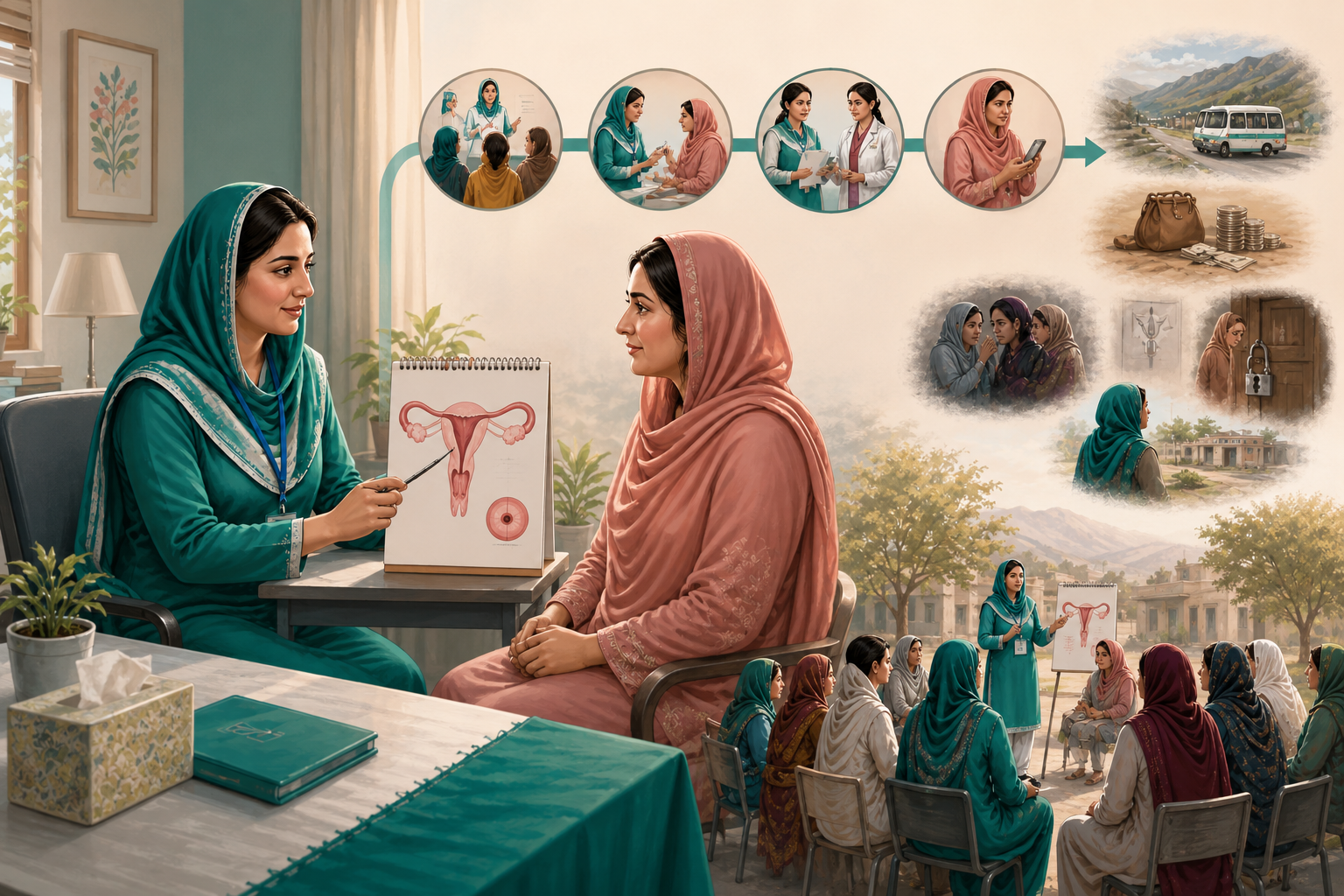
Introduction: Cervical cancer remains a major yet largely preventable health concern among women in Pakistan, where prevention is hindered by low awareness, sociocultural stigma, fear of gynecological examination, limited access to screening services, and a shortage of female healthcare providers. Objective: This narrative review synthesizes available evidence on cervical cancer screening awareness and uptake in Pakistan and explores how gynecology nurses can support prevention through education, counseling, community outreach, screening facilitation, referral guidance, and follow-up care. Methods: A structured narrative literature search was conducted using PubMed/MEDLINE, Scopus, CINAHL, Web of Science, Google Scholar, and relevant organizational reports, prioritizing literature published between 2015 and 2025. Following screening and eligibility assessment, 40 sources were included in the final narrative synthesis. Results: The reviewed evidence indicates that screening uptake in Pakistan is limited by inadequate knowledge, low perceived risk, embarrassment, stigma, cost, transportation difficulties, weak preventive health infrastructure, and the absence of organized screening pathways. Findings from Pakistan and comparable low-resource settings suggest that gynecology nurses are well positioned to improve screening awareness and access by providing culturally sensitive education, building trust, guiding women through available services, and supporting timely referral and follow-up. Conclusion: Strengthening the role of gynecology nurses through structured training, institutional protocols, and community-based outreach may improve cervical cancer screening awareness and support women’s access to preventive care in Pakistan.
References
- Agide, F. D., Garmaroudi, G., Sadeghi, R., Shakibazadeh, E., Yaseri, M., Koricha, Z. B., & Tigabu, B. M. (2018). A systematic review of the effectiveness of health education interventions to increase cervical cancer screening uptake. European Journal of Public Health, 28(6), 1156–1162. https://doi.org/10.1093/eurpub/cky197
- Ali, S. F., Ayub, S., Manzoor, N. F., Azim, S., Afif, M., Akhtar, N., Jafery, W. A., Tahir, I., Farid-ul-Hasnian, S., & Uddin, N. (2010). Knowledge and awareness about cervical cancer and its prevention amongst interns and nursing staff in tertiary care hospitals in Karachi, Pakistan. PLOS ONE, 5(6), e11059. https://doi.org/10.1371/journal.pone.0011059
- Andersen, R. M. (1995). Revisiting the behavioral model and access to medical care: Does it matter? Journal of Health and Social Behavior, 36(1), 1–10. https://doi.org/10.2307/2137284
- Arbyn, M., Weiderpass, E., Bruni, L., de Sanjosé, S., Saraiya, M., Ferlay, J., & Bray, F. (2020). Estimates of incidence and mortality of cervical cancer in 2018: A worldwide analysis. The Lancet Global Health, 8(2), e191–e203. https://doi.org/10.1016/S2214-109X(19)30482-6
- Batool, S. A., Sajjad, S., & Malik, H. (2017). Cervical cancer in Pakistan: A review. Journal of the Pakistan Medical Association, 67(7), 1074–1077.
- Bosch, F. X., Broker, T. R., Forman, D., Moscicki, A. B., Gillison, M. L., Doorbar, J., Stern, P. L., Stanley, M., Arbyn, M., Poljak, M., Cuzick, J., Castle, P. E., Schiller, J. T., Markowitz, L. E., Fisher, W. A., Canfell, K., Denny, L. A., Franco, E. L., Steben, M., … de Sanjosé, S. (2013). Comprehensive control of human papillomavirus infections and related diseases. Vaccine, 31(Suppl. 7), H1–H31. https://doi.org/10.1016/j.vaccine.2013.10.003
- Brisson, M., Kim, J. J., Canfell, K., Drolet, M., Gingras, G., Burger, E. A., Martin, D., Simms, K. T., Bénard, É., Boily, M.-C., Sy, S., Regan, C., Keane, A., Caruana, M., Nguyen, D. T. N., Smith, M. A., Laprise, J.-F., Jit, M., Alary, M., … Bruni, L. (2020). Impact of HPV vaccination and cervical screening on cervical cancer elimination: A comparative modelling analysis in 78 low-income and lower-middle-income countries. The Lancet, 395(10224), 575–590. https://doi.org/10.1016/S0140-6736(20)30068-4
- Bruni, L., Albero, G., Serrano, B., Mena, M., Collado, J. J., Gómez, D., Muñoz, J., Bosch, F. X., & de Sanjosé, S. (2023, March 10). Human papillomavirus and related diseases in Pakistan: Summary report. ICO/IARC Information Centre on HPV and Cancer. https://hpvcentre.net/statistics/reports/PAK.pdf
- Canfell, K., Kim, J. J., Brisson, M., Keane, A., Simms, K. T., Caruana, M., Burger, E. A., Martin, D., Nguyen, D. T. N., Bénard, É., Sy, S., Regan, C., Drolet, M., Gingras, G., Laprise, J.-F., Torode, J., Smith, M. A., Fidarova, E., Trapani, D., … Bruni, L. (2020). Mortality impact of achieving WHO cervical cancer elimination targets: A comparative modelling analysis in 78 low-income and lower-middle-income countries. The Lancet, 395(10224), 591–603. https://doi.org/10.1016/S0140-6736(20)30157-4
- Denny, L., de Sanjose, S., Mutebi, M., Anderson, B. O., Kim, J., Jeronimo, J., Herrero, R., Yeates, K., Ginsburg, O., Sankaranarayanan, R., & Schiffman, M. (2017). Interventions to close the divide for women with breast and cervical cancer between low-income and middle-income countries and high-income countries. The Lancet, 389(10071), 861–870. https://doi.org/10.1016/S0140-6736(16)31795-0
- Everett, T., Bryant, A., Griffin, M. F., Martin-Hirsch, P. P. L., Forbes, C. A., & Jepson, R. G. (2021). Interventions targeted at women to encourage the uptake of cervical screening. Cochrane Database of Systematic Reviews, 2021(9), CD002834. https://doi.org/10.1002/14651858.CD002834.pub3
- Fontham, E. T. H., Wolf, A. M. D., Church, T. R., Etzioni, R., Flowers, C. R., Herzig, A., Guerra, C. E., Oeffinger, K. C., Shih, Y.-C. T., Walter, L. C., Kim, J. J., Andrews, K. S., DeSantis, C. E., Fedewa, S. A., Manassaram-Baptiste, D., Saslow, D., Wender, R. C., & Smith, R. A. (2020). Cervical cancer screening for individuals at average risk: 2020 guideline update from the American Cancer Society. CA: A Cancer Journal for Clinicians, 70(5), 321–346. https://doi.org/10.3322/caac.21628
- Gakidou, E., Nordhagen, S., & Obermeyer, Z. (2008). Coverage of cervical cancer screening in 57 countries: Low average levels and large inequalities. PLOS Medicine, 5(6), e132. https://doi.org/10.1371/journal.pmed.0050132
- Hirani, S., Khan, S., Akram, S., Virji, S. N., Shaikh, P. A., Naeem, E., Chaudhry, R. A., Khalid, A. B., Khan, J. U. D., Qasim, M. S., & Jehan, I. (2021). Knowledge, awareness, and practices of cervical cancer, its risk factors, screening, and prevention among women in Karachi, Pakistan. European Journal of Cancer Prevention, 30(1), 97–102. https://doi.org/10.1097/CEJ.0000000000000590
- Imam, S. Z., Rehman, F., Zeeshan, M. M., Maqsood, B., Asrar, S., Fatima, N., Ali, S. M., & Jabeen, K. (2008). Perceptions and practices of a Pakistani population regarding cervical cancer screening. Asian Pacific Journal of Cancer Prevention, 9(1), 42–44.
- International Council of Nurses, & European Forum of National Nurses and Midwives Associations. (2022). Roadmap to accelerate the elimination of cervical cancer as a public health problem in the WHO European Region 2022–2030: Joint statement to the 72nd session of the WHO Regional Committee for Europe. https://www.icn.ch/sites/default/files/2023-05/WHO%20EURO_RC%2072_Item9_CervicalCancerRoadmap_ICN%20EFNNMA%20statement.pdf
- International Council of Nurses. (2022). Nurses: A voice to lead—Invest in nursing and respect rights to secure global health. https://www.icn.ch/sites/default/files/2023-05/IND2022_Report_EN.pdf
- Khan, F. Z. A., Mazhar, S. B., & Itua, I. (2025). Knowledge, attitudes and practices of cervical cancer screening among women attending gynecology clinics at tertiary care hospitals in the capital city of Pakistan: A cross-sectional survey. Asian Pacific Journal of Cancer Prevention, 26(8), 2819–2825. https://doi.org/10.31557/APJCP.2025.26.8.2819
- Li, C., Liu, Y., Xue, D., & Chan, C. W. H. (2020). Effects of nurse-led interventions on early detection of cancer: A systematic review and meta-analysis. International Journal of Nursing Studies, 110, 103684. https://doi.org/10.1016/j.ijnurstu.2020.103684
- Majid, E., Shaikh, M. A., Qazi, O. A., Khan, S., Majeed, I., & Bano, K. (2022). Awareness, screening, practices and attitudes of cervical cancer among doctors and nursing staff working at a tertiary care centre. Journal of the Pakistan Medical Association, 72(6), 1025–1030. https://doi.org/10.47391/JPMA.1443
- Marlow, L. A. V., Chorley, A. J., Haddrell, J., Ferrer, R., & Waller, J. (2017). Understanding the heterogeneity of cervical cancer screening non-participants: Data from a national sample of British women. European Journal of Cancer, 80, 30–38. https://doi.org/10.1016/j.ejca.2017.04.017
- Modibbo, F., Iregbu, K. C., Okuma, J., Leeman, A., Kasius, A., de Koning, M., Adebamowo, C., Adewole, I., & Snijders, P. J. F. (2017). Randomized trial evaluating self-sampling for HPV DNA-based tests for cervical cancer screening in Nigeria. Infectious Agents and Cancer, 12, 11. https://doi.org/10.1186/s13027-017-0123-z
- Musa, J., Achenbach, C. J., O'Dwyer, L. C., Evans, C. T., McHugh, M., Hou, L., Simon, M. A., Murphy, R. L., & Jordan, N. (2017). Effect of cervical cancer education and provider recommendation for screening on screening rates: A systematic review and meta-analysis. PLOS ONE, 12(9), e0183924. https://doi.org/10.1371/journal.pone.0183924
- Ncube, B., Bey, A., Knight, J., Bessler, P., & Jolly, P. E. (2015). Factors associated with the uptake of cervical cancer screening among women in Portland, Jamaica. North American Journal of Medical Sciences, 7(3), 104–113. https://doi.org/10.4103/1947-2714.153922
- Page, M. J., McKenzie, J. E., Bossuyt, P. M., Boutron, I., Hoffmann, T. C., Mulrow, C. D., Shamseer, L., Tetzlaff, J. M., Akl, E. A., Brennan, S. E., Chou, R., Glanville, J., Grimshaw, J. M., Hróbjartsson, A., Lalu, M. M., Li, T., Loder, E. W., Mayo-Wilson, E., McDonald, S., ... Moher, D. (2021). The PRISMA 2020 statement: An updated guideline for reporting systematic reviews. BMJ, 372, n71. https://doi.org/10.1136/bmj.n71
- Perkins, R. B., Guido, R. S., Castle, P. E., Chelmow, D., Einstein, M. H., Garcia, F., Huh, W. K., Kim, J. J., Moscicki, A. B., Nayar, R., Saraiya, M., Sawaya, G. F., Wentzensen, N., Schiffman, M., & Spitzer, M. (2020). 2019 ASCCP risk-based management consensus guidelines for abnormal cervical cancer screening tests and cancer precursors. Journal of Lower Genital Tract Disease, 24(2), 102–131. https://doi.org/10.1097/LGT.0000000000000525
- Rees, I., Jones, D., Chen, H., & Macleod, U. (2018). Interventions to improve the uptake of cervical cancer screening among lower socioeconomic groups: A systematic review. Preventive Medicine, 111, 323–335. https://doi.org/10.1016/j.ypmed.2017.11.019
- Riaz, L., Manazir, S., Jawed, F., Ali, S. A., & Riaz, R. (2020). Knowledge, perception, and prevention practices related to human papillomavirus-based cervical cancer and its socioeconomic correlates among women in Karachi, Pakistan. Cureus, 12(3), e7183. https://doi.org/10.7759/cureus.7183
- Rosser, J. I., Njoroge, B., & Huchko, M. J. (2015). Changing knowledge, attitudes, and behaviors regarding cervical cancer screening: The effects of an educational intervention in rural Kenya. Patient Education and Counseling, 98(7), 884–889. https://doi.org/10.1016/j.pec.2015.03.017
- Rosenstock, I. M., Strecher, V. J., & Becker, M. H. (1988). Social learning theory and the Health Belief Model. Health Education Quarterly, 15(2), 175–183. https://doi.org/10.1177/109019818801500203
- Sankaranarayanan, R., Nene, B. M., Shastri, S. S., Jayant, K., Muwonge, R., Budukh, A. M., Hingmire, S., Malvi, S. G., Thorat, R., Kothari, A., Chinoy, R., Kelkar, R., Kane, S., Desai, S., Keskar, V. R., Rajeshwarkar, R., Panse, N., & Dinshaw, K. A. (2009). HPV screening for cervical cancer in rural India. The New England Journal of Medicine, 360(14), 1385–1394. https://doi.org/10.1056/NEJMoa0808516
- Schiffman, M., Wentzensen, N., Wacholder, S., Kinney, W., Gage, J. C., & Castle, P. E. (2011). Human papillomavirus testing in the prevention of cervical cancer. Journal of the National Cancer Institute, 103(5), 368–383. https://doi.org/10.1093/jnci/djq562
- Shahnaz, S., Fricovsky, E., Anwar, R., & Arain, M. I. (2023). Cervical cancer awareness and attitude towards cervical cancer screening and human papillomavirus vaccines among urban women of Karachi, Pakistan. Cureus, 15(8), e42970. https://doi.org/10.7759/cureus.42970
- Shamaun, S., Jaleel, R., Gull, Y., Shahid, A., Iqbal, M., & Qazi, T. N. (2023). Knowledge and attitude of cervical cancer screening and vaccination in patients attending gynecology outpatient clinic at a tertiary care hospital in Pakistan. South Asian Journal of Cancer, 12(1), 17–22. https://doi.org/10.1055/s-0042-1751093
- Shrestha, A. D., Neupane, D., Vedsted, P., & Kallestrup, P. (2018). Cervical cancer prevalence, incidence and mortality in low- and middle-income countries: A systematic review. Asian Pacific Journal of Cancer Prevention, 19(2), 319–324. https://doi.org/10.22034/APJCP.2018.19.2.319
- Simms, K. T., Steinberg, J., Caruana, M., Smith, M. A., Lew, J. B., Soerjomataram, I., Castle, P. E., Bray, F., & Canfell, K. (2019). Impact of scaled up human papillomavirus vaccination and cervical screening and the potential for global elimination of cervical cancer in 181 countries, 2020–99: A modelling study. The Lancet Oncology, 20(3), 394–407. https://doi.org/10.1016/S1470-2045(18)30836-2
- Smith, R. A., Andrews, K. S., Brooks, D., Fedewa, S. A., Manassaram-Baptiste, D., Saslow, D., & Wender, R. C. (2019). Cancer screening in the United States, 2019: A review of current American Cancer Society guidelines and current issues in cancer screening. CA: A Cancer Journal for Clinicians, 69(3), 184–210. https://doi.org/10.3322/caac.21557
- Sung, H., Ferlay, J., Siegel, R. L., Laversanne, M., Soerjomataram, I., Jemal, A., & Bray, F. (2021). Global cancer statistics 2020: GLOBOCAN estimates of incidence and mortality worldwide for 36 cancers in 185 countries. CA: A Cancer Journal for Clinicians, 71(3), 209–249. https://doi.org/10.3322/caac.21660
- Tchounga, B., Boni, S. P., Koffi, J. J., Horo, A. G., & Jaquet, A. (2023). Interventions to increase the uptake of cervical cancer screening in low- and middle-income countries: A systematic review and meta-analysis. BMC Women's Health, 23, 67. https://doi.org/10.1186/s12905-023-02265-8
- Tricco, A. C., Lillie, E., Zarin, W., O'Brien, K. K., Colquhoun, H., Levac, D., Moher, D., Peters, M. D. J., Horsley, T., Weeks, L., Hempel, S., Akl, E. A., Chang, C., McGowan, J., Stewart, L., Hartling, L., Aldcroft, A., Wilson, M. G., Garritty, C., ... Straus, S. E. (2018). PRISMA extension for scoping reviews (PRISMA-ScR): Checklist and explanation. Annals of Internal Medicine, 169(7), 467–473. https://doi.org/10.7326/M18-0850
- Wentzensen, N., Clarke, M. A., & Perkins, R. B. (2021). Impact of COVID-19 on cervical cancer screening: Challenges and opportunities to improving resilience and reduce disparities. Preventive Medicine, 151, 106596. https://doi.org/10.1016/j.ypmed.2021.106596
- World Health Organization. (2020). Global strategy to accelerate the elimination of cervical cancer as a public health problem. https://www.who.int/publications/i/item/9789240014107
- World Health Organization. (2021). WHO guideline for screening and treatment of cervical pre-cancer lesions for cervical cancer prevention (2nd ed.). https://www.who.int/publications/i/item/9789240030824
- World Health Organization. (2024). Cervical cancer. https://www.who.int/news-room/fact-sheets/detail/cervical-cancer