
Assessing the Motivations of Nursing Students Graduated from Non-STEM SHS Strands to Pursue BSN
 Julian Grayfrex A. Alcomendas
- Drexel Heinz Cruz
Published 2025-12-31
Keywords
- Bachelor of Science in Nursing,
- Career Choice,
- Motivations,
- Students,
- Theory of Planned Behavior
How to Cite
Abstract
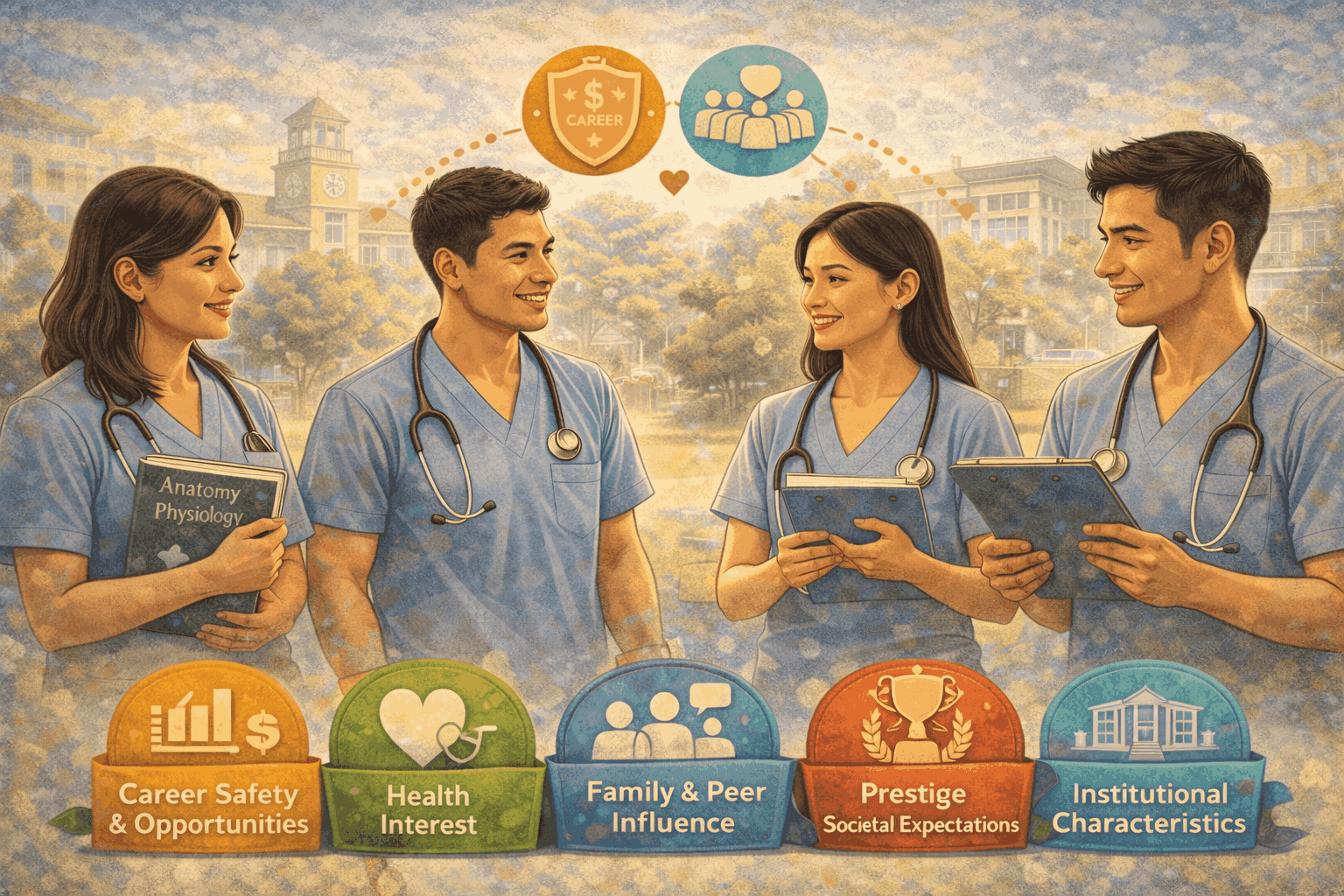
Introduction: Previous studies on nursing career choice commonly emphasize interest in healthcare, job security, and social influence; however, limited literature explores why non-STEM Senior High School graduates pursue the Bachelor of Science in Nursing (BSN), particularly in the Philippine context. Objective: This study aims to contribute to the knowledge base of the nursing profession and catalyze or help develop positive changes and improvements in different sectors. Methods: This quantitative descriptive-correlational study examined the factors influencing BSN students who did not graduate from STEM strands in Senior High School to pursue a nursing career, guided by the Theory of Planned Behavior (TPB). Using purposive non-random sampling, 105 participants completed a survey assessing career opportunities and job safety, interest in healthcare, family and peer influence, perceived prestige, institutional characteristics, and selected demographic variables. Data were analyzed using descriptive statistics, one-way analysis of variance, and multiple regression analysis. Results: Career opportunities and job safety (M = 3.36) and perceived prestige and societal expectations (M = 3.26) were strongly influential in career choice. Interest in healthcare (M = 2.98) and institutional characteristics (M = 2.94) were influential, whereas family and peer influence (M = 2.42) was not. TPB assessment showed a very positive attitude toward BSN (M = 3.55), moderate parental influence (M = 2.97), and moderate perceived behavioral control (M = 2.95). Demographic variables were not significantly associated with any factor. Among TPB constructs, attitude, parental subjective norms, and perceived behavioral control significantly influenced career choice. Conclusion: The study concludes that non-STEM students’ motivation to pursue BSN is driven primarily by career-related considerations rather than social influence or prior academic alignment.
References
- Ali, D. A., Ncila, O., Ouhhamou, S., Rizzo, A., Chirico, F., & Khabbache, H. (2024). Motivations driving career choices: Insights from a study among nursing students. SAGE Open Nursing, 10. https://doi.org/10.1177/23779608241255876
- Choi, H., & Rajaguru, V. (2024). Influencing factors on career preparation behavior of nursing students in the post COVID-19 era. Nursing Reports, 14(1), 545–555. https://doi.org/10.3390/nursrep14010042
- Choudhary, K. (2024). An approach to enhancing continuous evaluation through self-reflection among students of the foundation program in design course. Creative Education, 15(6), 1003–1011. https://doi.org/10.4236/ce.2024.156061
- Christensen, S., Davies, R. S., Larsen, R. A. A., Harris, S., Hanks, J., & Bowles, B. (2022). Parental perceptions of the teaching profession: Factors that predict parental encouragement of students to enter the teaching profession. Education Sciences, 12(11), Article 734. https://doi.org/10.3390/educsci12110734
- Čukljek, S., Babić, J., Hošnjak, A. M., Fičko, S. L., & Smrekar, M. (2020a). Reasons for student enrollment in nursing studies. Croatian Nursing Journal, 4(2), 183–191. https://doi.org/10.24141/2/4/2/4
- Derban, P., Negrea, R., Rominu, M., & Marsavina, L. (2021). Influence of the printing angle and load direction on flexure strength in 3D printed materials for provisional dental restorations. Materials, 14(12), Article 3376. https://doi.org/10.3390/ma14123376
- Etherton, K., Steele-Johnson, D., Salvano, K., & Kovacs, N. (2020). Resilience effects on student performance and well-being: The role of self-efficacy, self-set goals, and anxiety. The Journal of General Psychology, 149(3), 279–298. https://doi.org/10.1080/00221309.2020.1835800
- Fontanilla, D. M. C., Rebollido, C. T., Anacito, A. E. M. M. V., Algar, C. F., Cruz, J. M. D., Herrera, M. C., Palcon, M., Lim, A., & Apolinar, H. A. (2023a). Reasons for the choice of nursing as a career among students in a private university in Manila, Philippines. International Journal of Advanced Research, 11(8), 679–683. https://doi.org/10.21474/ijar01/17437
- Hadiyati, M. A., & Astuti, B. (2023). Student careers: What factors influence career choice? Journal of Education Research and Evaluation, 7(4), 608–614. https://doi.org/10.23887/jere.v7i4.61686
- Kallio, H., Kangasniemi, M., & Hult, M. (2022). Registered nurses’ perceptions of their career—An interview study. Journal of Nursing Management, 30(7), 3378–3385. https://doi.org/10.1111/jonm.13796
- Kovner, C. (2022). COVID‐19 and the supply and demand for registered nurses. International Nursing Review, 69(2), 118–120. https://doi.org/10.1111/inr.12759
- Lee, T., Lee, S. J., Yoon, Y. S., Ji, H., Yoon, S., Lee, S., & Ji, Y. (2023). Personal factors and clinical learning environment as predictors of nursing students’ readiness for practice: A structural equation modeling analysis. Asian Nursing Research, 17(1), 44–52. https://doi.org/10.1016/j.anr.2023.01.003
- Liaw, S. Y., Wu, L. T., Chow, Y. L., Lim, S., & Tan, K. K. (2017). Career choice and perceptions of nursing among healthcare students in higher educational institutions. Nurse Education Today, 52, 66–72. https://doi.org/10.1016/j.nedt.2017.02.008
- Lin, Y., Wang, X., Zhang, X., Hu, H., Liu, L., Pang, K., Li, Y., Hu, C., Sun, Z., & Li, X. (2025). The impact of undergraduate nursing students’ time management disposition on innovative behavior: The chain mediating role of academic self-efficacy and flow experience. Frontiers in Psychology, 16. https://doi.org/10.3389/fpsyg.2025.1447121
- Ling, P., Hong, L. C. M., & Yun, L. S. (2021). Determinant factors in selecting university: Evidence from secondary school students in Sarawak. International Journal of Academic Research in Progressive Education and Development, 10(3). https://doi.org/10.6007/ijarped/v10-i3/11018
- Macayana, F. B. (2025). From senior high to science education: Factors influencing NonSTEM senior high school graduates in choosing BSE science as their degree program. Pakistan Journal of Life and Social Sciences (PJLSS), 23(1). https://doi.org/10.57239/pjlss-2025-23.1.00545
- McKenna, L., Mambu, I. R., Sommers, C. L., Reisenhofer, S., & McCaughan, J. (2023a). Nurses’ and nursing students’ reasons for entering the profession: Content analysis of open-ended questions. BMC Nursing, 22(1). https://doi.org/10.1186/s12912-023-01307-8
- Moses, P., Cheah, P., Tey, T., & Chiew, J. (Eds.). (2020). Development of the theory of planned behaviour questionnaire: Students’ career choices in STEM (28th ed.). International Conference on Computers in Education.
- Muñoz, L. R. (2020). Graduate student self-efficacy: Implications of a concept analysis. Journal of Professional Nursing, 37(1), 112–121. https://doi.org/10.1016/j.profnurs.2020.07.001
- Neumbe, I. M., Ssenyonga, L., Soita, D. J., Iramiot, J. S., & Nekaka, R. (2023). Attitudes and perceptions of undergraduate nursing students towards the nursing profession. PLoS ONE, 18(7), Article e0280700. https://doi.org/10.1371/journal.pone.0280700
- Owusu, M. K., Owusu, A., Fiorgbor, E. T., & Atakora, J. (2021). Career aspiration of students: The influence of peers, teachers and parents. Journal of Education Society and Behavioural Science, 67–79. https://doi.org/10.9734/jesbs/2021/v34i230306
- Pourhaji, F., Jamali, J., Taraghdar, M. M., Peyman, N., & Tehrani, H. (2024). Design and validation of a questionnaire on the factors influencing self-care behaviors in patients with multiple sclerosis (QFASMS). BMC Neurology, 24(1). https://doi.org/10.1186/s12883-023-03522-x
- Pujilestari, S., Sayuti, M., & Tentama, F. (2021). The influence of parental guidance, group of peers, school promotion, and career information on course preference decision class X SMK Muhammadiyah in Bantul. Journal of Vocational Education Studies, 4(1), Article 11. https://doi.org/10.12928/joves.v4i1.2073
- Qiu, P., Wang, H., Wang, H., Miao, L., & Song, J. (2025). The relationship between college students’ self-identity and future orientation: A moderated chain-mediating model. Frontiers in Psychology, 16. https://doi.org/10.3389/fpsyg.2025.1461159
- Regulacion, C. A. D. (2022). Influence on career preferences of the senior high school graduating students. International Journal of Research Publications, 104(1). https://doi.org/10.47119/ijrp1001041720223572
- Schober, P., & Vetter, T. R. (2020). Nonparametric statistical methods in medical research. Anesthesia & Analgesia, 131(6), 1862–1863. https://doi.org/10.1213/ane.0000000000005101
- Shaikh, F., Solangi, M., & Abro, S. (2020). Performance of post graduate students using multiple regression analysis (Case study). Mathematical Theory and Modeling, 10(8), 1–9. https://doi.org/10.7176/mtm/10-8-01
- Shatz, I. (2023). Assumption-checking rather than (just) testing: The importance of visualization and effect size in statistical diagnostics. Behavior Research Methods, 56(2), 826–845. https://doi.org/10.3758/s13428-023-02072-x
- Sherwani, R. A. K., Shakeel, H., Awan, W. B., Faheem, M., & Aslam, M. (2021). Analysis of COVID-19 data using neutrosophic Kruskal Wallis H test. BMC Medical Research Methodology, 21(1). https://doi.org/10.1186/s12874-021-01410-x
- Stoica, R. E., Bota, O. A., & Cazan, A. (2025). Dimensions of career decisions: A validated tool for Romanian high school students. Education Sciences, 15(6), Article 703. https://doi.org/10.3390/educsci15060703
- Tamimi, N. N. M. A., Mashrafi, O. M. S. A., & Thottoli, M. M. (2023). Exploring the factors that influence university selection: Insights from college students. Journal of Business Management Review, 4(6), 439–454. https://doi.org/10.47153/jbmr46.7142023
- Teresa-Morales, C., Rodríguez-Pérez, M., & Ramos-Pichardo, J. D. (2023). Reasons for choosing and completing nursing studies among incoming and outgoing students: A qualitative study. Nurse Education Today, 125, Article 105794. https://doi.org/10.1016/j.nedt.2023.105794
- Wang, X., Dai, M., & Short, K. M. (2024). One size doesn’t fit all: How different types of learning motivations influence engineering undergraduate students’ success outcomes. International Journal of STEM Education, 11(1). https://doi.org/10.1186/s40594-024-00502-6