
Trauma Care Performance in Western China: A Single-Center Benchmark Analysis Using Provincial and National Trauma Registry Data
 Xixi Li
Published 2026-04-12
Keywords
- Trauma,
- Trauma Registry,
- Mortality,
- Injury Severity Score,
- Benchmarking
How to Cite
Abstract
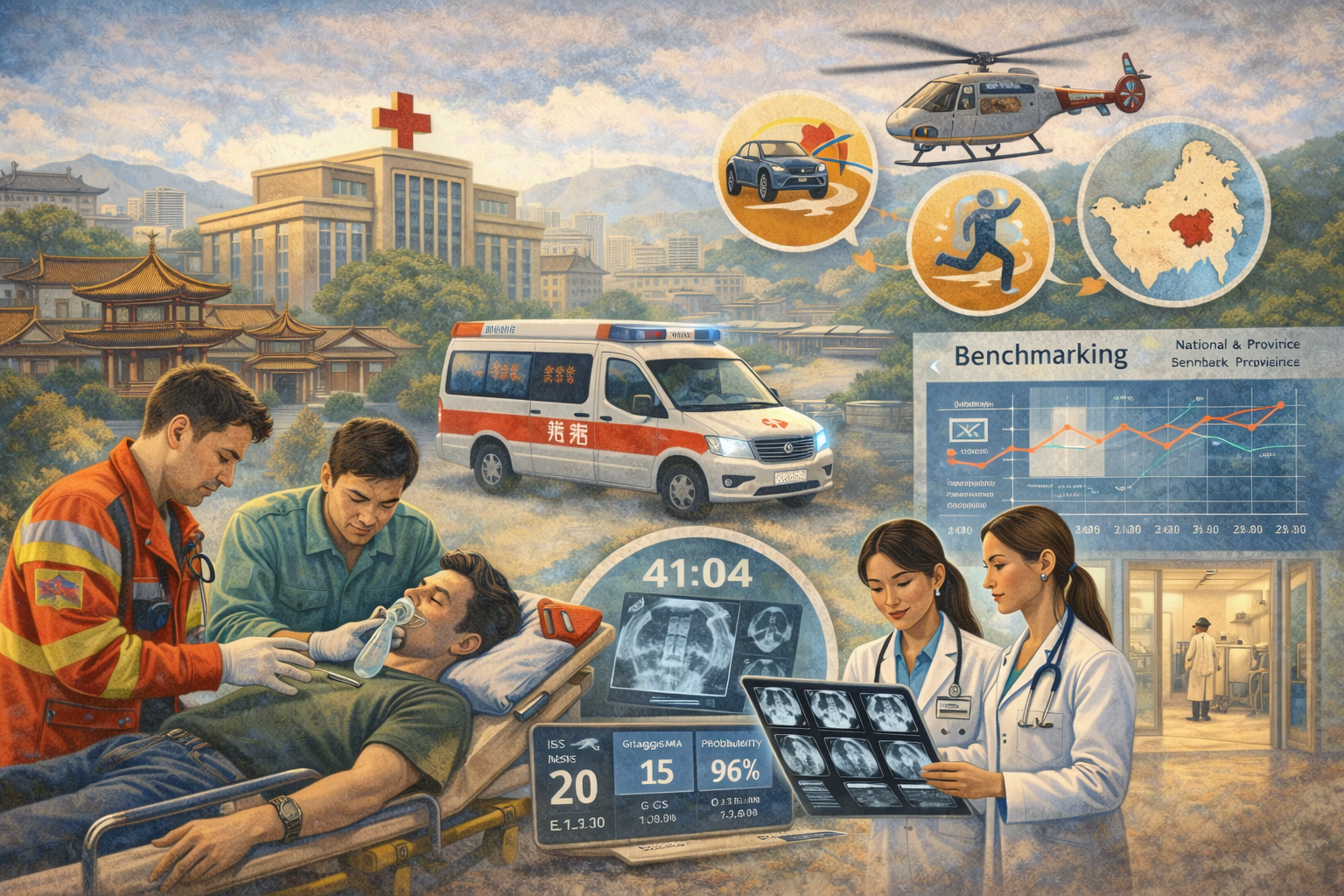
Introduction: With urbanization, trauma has become a critical public health issue in western China. However, detailed performance evaluations of regional trauma centers using provincial and national registry benchmarks remain limited. Objective: This study aimed to investigate the clinical characteristics of trauma patients and evaluate the operational efficiency and outcomes of a tertiary trauma center in Suining using provincial and national benchmarks. Methods: A retrospective secondary analysis was conducted using the China Trauma Rescue Consortium (CTRC) database. Patient-level data were derived from a tertiary Grade A hospital in western Sichuan Province, while aggregated provincial and national CTRC data were used for benchmarking. A total of 8,257 patients treated between September 2021 and February 2025 were included. Descriptive statistics, univariate analysis, and multivariable binary logistic regression were performed using SPSS version 26.0. Statistical significance was set at p < 0.05. Results: Falls (including ground-level and height-related) and traffic-related injuries were the primary mechanisms of injury. The center demonstrated faster emergency department preparation time (4.03 min vs. 8.37 min nationally) and a lower mortality rate for severe trauma (1.67% vs. 2.32%). However, door-to-CT completion time (41.04 min) remained longer than benchmark values. The regression model showed high explanatory power (Nagelkerke R² = 0.96). Age (OR = 1.03, p = 0.01), ISS (OR = 1.24, p < 0.01), and GCS (OR = 0.62, p < 0.01) were significant independent predictors of 30-day mortality. Conclusion: This benchmarking analysis demonstrated strong early response performance but identified delays in diagnostic imaging workflows. Improving door-to-CT efficiency may further enhance trauma care outcomes in western China.
References
- Baker, S. P., O’Neill, B., Haddon, W., & Long, W. B. (1974). The injury severity score: A method for describing patients with multiple injuries and evaluating emergency care. Journal of Trauma, 14(3), 187–196. https://doi.org/10.1097/00005373-197403000-00001
- Boyd, C. R., Tolson, M. A., & Copes, W. S. (1987). Evaluating trauma care: The TRISS method. Journal of Trauma, 27(4), 370–378. https://doi.org/10.1097/00005373-198704000-00005
- Brinck, T., Heinänen, M., Handolin, L., & Söderlund, T. (2021). Trauma-registry survival outcome follow-up: 30 days is mandatory and appears sufficient. Injury, 52(2), 142–146. https://doi.org/10.1016/j.injury.2020.11.011
- Chen, Q., Qin, Y., Jin, Z., Zhao, X., He, J., Wu, C., & Tang, B. (2024). Enhancing performance of the national field triage guidelines using machine learning: Development of a prehospital triage model to predict severe trauma. Journal of Medical Internet Research, 26(8), e58740. https://doi.org/10.2196/58740
- General Office of the National Health Commission of the People’s Republic of China. (2019, September 5). Notice of the General Office of the National Health Commission on issuing the standards for the establishment of national trauma medical centers and national regional trauma medical centers [in Chinese]. https://www.nhc.gov.cn/yzygj/c100068/201909/0cc1c3ca615c416898edd6b70532deab.shtml
- Goddard, S. D., Jarman, M. P., & Hashmi, Z. G. (2024). Societal burden of trauma and disparities in trauma care. Surgical Clinics of North America, 104(2), 255–266. https://doi.org/10.1016/j.suc.2023.09.009
- Huang, W., Xu, T., Wang, T., Jiang, B., & Medical Quality Control Committee of National Trauma Medical Center. (2024). Expert consensus on key indicators for quality control in trauma medicine center. Journal of Peking University Health Sciences, 56(3), 551–555. https://doi.org/10.19723/j.issn.1671-167X.2024.03.025
- Huber-Wagner, S., Lefering, R., & Qvick, L. M. (2009). Effect of whole-body CT during trauma resuscitation on survival: A retrospective, multicentre study. The Lancet, 373(9673), 1455–1461. https://doi.org/10.1016/S0140-6736(09)60232-4
- Iddagoda, M. T., Trevenen, M., Meaton, C., Etherton-Beer, C., & Flicker, L. (2024). Identifying factors predicting outcomes after major trauma in older patients: Prognostic systematic review and meta-analysis. Journal of Trauma and Acute Care Surgery, 97(3), 478–487. https://doi.org/10.1097/TA.0000000000004320
- Li, Y., Lang, L., Zhang, J., Bao, Q., Long, R., Huang, Z., Li, Z., & Zhang, L. (2026). Chinese expert consensus on the prehospital management of major trauma. Chinese Journal of Traumatology, 29(2), 79–89. https://doi.org/10.1016/j.cjtee.2026.01.002
- Ordoñez, C. A., Parra, M. W., Salcedo, A., Pino, L. F., Millán, M., Badiel, M., García, A., Serna, J. J., Caicedo, Y., Padilla, N., Orlas, C. P., Herrera, M. A., Castro, M. D., & Ferrada, R. (2020). Implementation of a new single-pass whole-body computed tomography protocol: Is it safe, effective and efficient in patients with severe trauma? Colombia Médica, 51(1), e4224. https://doi.org/10.25100/cm.v51i1.4224
- Saar, S., Brinck, T., Laos, J., Handolin, L., & Talving, P. (2019). Severe blunt trauma in Finland and Estonia: Comparison of two regional trauma repositories. European Journal of Trauma and Emergency Surgery, 46(2), 371–376. https://doi.org/10.1007/s00068-018-01068-z
- Tang, X., Deng, Y., Yang, H., Tian, F., Li, Y., & Pan, J. (2020). Spatial accessibility to emergency care in Sichuan province in China. Geospatial Health, 15(2), 891. https://doi.org/10.4081/gh.2020.891
- Teasdale, G., & Jennett, B. (1974). Assessment of coma and impaired consciousness: A practical scale. The Lancet, 304(7872), 81–84. https://doi.org/10.1016/S0140-6736(74)91639-0
- World Health Organization. (2021). Falls: Fact sheet. https://www.who.int/news-room/fact-sheets/detail/falls
- Xiong, C., Xia, Y., Chen, H., & Cheng, J. (2024). Regional inequality and associated factors of emergency medicine beds distribution in China. International Journal of Public Health, 69, 1606812. https://doi.org/10.3389/ijph.2024.1606812
- Yadav, K., Lampron, J., Nadj, R., Raichura, R., Figueira, S., Nemnom, M.-J., Taljaard, M., Émond, M., Benhamed, A., & Eagles, D. (2023). Predictors of mortality among older major trauma patients. Canadian Journal of Emergency Medicine, 25(11), 865–872. https://doi.org/10.1007/s43678-023-00597-w
- Yamamoto, R., Suzuki, M., Funabiki, T., & Sasaki, J. (2023). Immediate CT after hospital arrival and decreased in-hospital mortality in severely injured trauma patients. BJS Open, 7(1), zrac133. https://doi.org/10.1093/bjsopen/zrac133
- Yin, G., Chen, C., Zhuo, L., He, Q., & Tao, H. (2021). Efficiency comparison of public hospitals under different administrative affiliations in China: A pilot city case. Healthcare, 9(4), 437. https://doi.org/10.3390/healthcare9040437