
Emergence Delirium Among Older Adults in the Post-Anesthesia Care Unit: A Rapid Review
 Simon Paul P. Navarro
Published 2026-04-12
Keywords
- Older Adults,
- Frailty,
- Postoperative Delirium,
- Perioperative Nursing,
- Postoperative Complications
- Perioperative Care ...More
How to Cite
Abstract
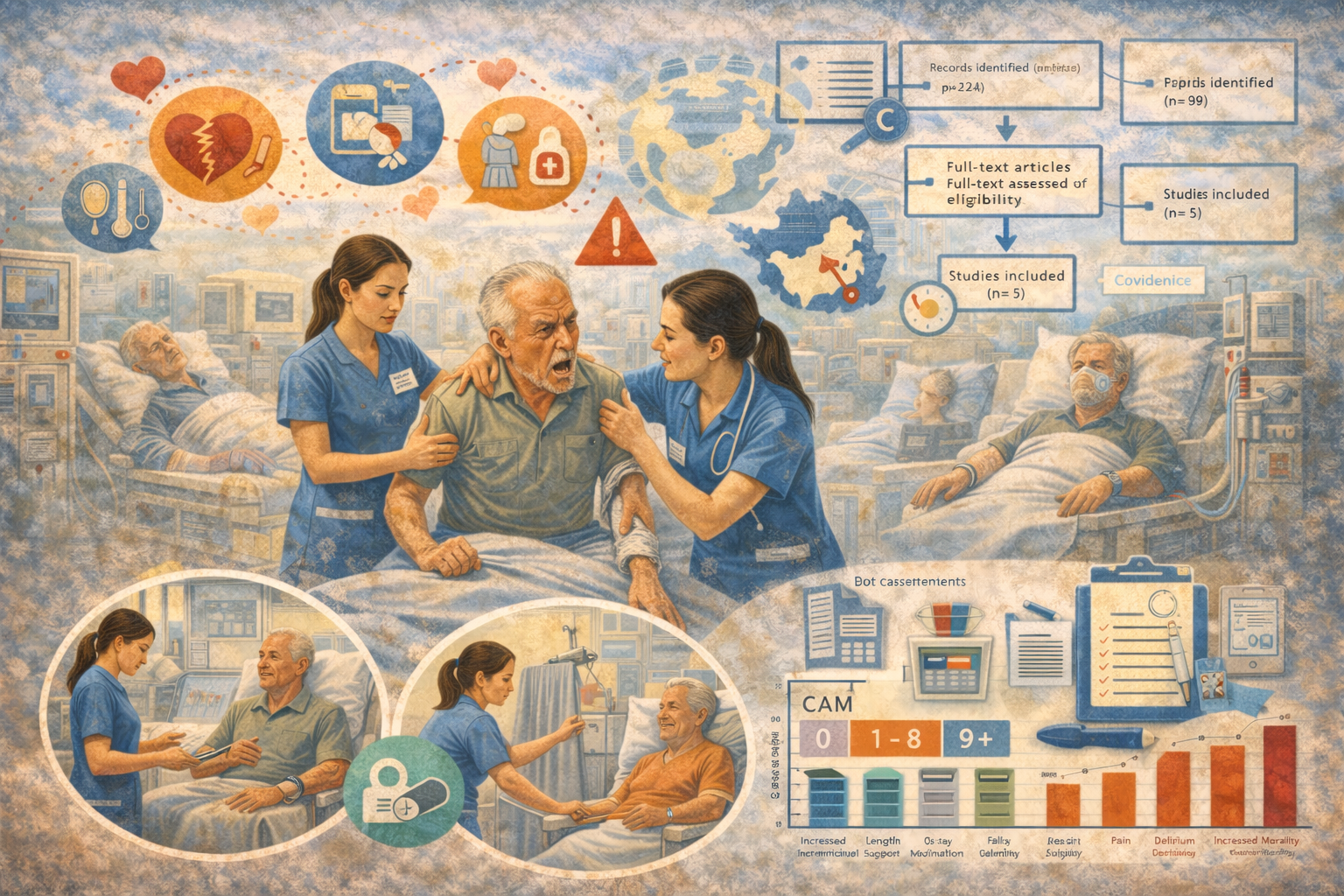
Introduction: Emergence delirium (ED) has been commonly recognized as a critical event within the postoperative period. Yet, evidence on its prevalence and clinical implications among older adults remains limited in the current body of knowledge. Objective: The aim of this rapid review was to elucidate and synthesize existing literature related to the key characteristics of ED and its clinical implications among older adult patients in post-anesthesia care units. Methods: The Oxford’s rapid review framework, Aveyard’s thematic analysis approach, and PRISMA checklist were followed. A systematic literature search was conducted in March 2025 across four electronic databases, including Embase, MEDLINE, CINAHL, and PubMed. Covidence software was used to assess identified primary research. The American Association of Critical-Care Nurses’ Levels of Evidence was employed to appraise and evaluate the clinical relevance of the included articles. Two authors independently screened the full text records and finalized the data extraction process. Results: Of 224 records initially screened, 69 full-text articles were assessed for eligibility, and five met the inclusion criteria. All included studies were mainly from China (n = 4) and Ethiopia (n = 1) and classified as Level C evidence. Characteristics of ED in older adults, including its risk factors, signs and symptoms, assessment tools, management strategies, and impact on patient outcomes were narratively reported in this review. Conclusion: Emergence delirium has been found to be an independent condition that potentially influences outcomes among older adult patients. The overlapping clinical picture of ED with emergence agitation and postoperative delirium warrants areas for future scientific investigation to establish accurate diagnostic tools and management for ED to improve overall patient care delivery and outcomes.
References
- Assefa, M. T., Chekol, W. B., Melesse, D. Y., Nigatu, Y. A., & Bizuneh, Y. B. (2022). Incidence and risk factors of emergence delirium in elderly patients after general or spinal anesthesia for both elective and emergency surgery. Annals of Medicine and Surgery, 84, 104959. https://doi.org/10.1016/j.amsu.2022.104959
- Aoyama, K., Furuta, M., Ameye, L., Petre, M. A., Englesakis, M., Rana, M., Gai, N., Peliowski, A., & Saha, B. (2025). Risk factors for pediatric emergence delirium: A systematic review. Canadian Journal of Anaesthesia, 72(3), 384–396. https://doi.org/10.1007/s12630-024-02889-w
- Aveyard, H. (2023). Doing a literature review in health and social care: A practical guide (5th ed.). Open University Press.
- Ban, W. J., Lee, J. M., & Nam, S. H. (2024). Influence of emergence delirium-related knowledge and nursing stress, practice, and confidence levels on the performance of recovery room nurses: A cross-sectional study. PLoS ONE, 19(12), e0314575. https://doi.org/10.1371/journal.pone.0314575
- Cai, B. Y., He, S. T., Zhang, Y., Ma, J. H., Mu, D. L., & Wang, D. X. (2024). Impact of emergence delirium on long-term survival in older patients after major noncardiac surgery: A longitudinal prospective observational study. Journal of Clinical Anesthesia, 99, 111663. https://doi.org/10.1016/j.jclinane.2024.111663
- Cascella, M., Bimonte, S., & Muzio, M. R. (2018). Towards a better understanding of anesthesia emergence mechanisms: Research and clinical implications. World Journal of Methodology, 8(2), 9–16. https://doi.org/10.5662/wjm.v8.i2.9
- Chen, Y. C., Foster, J., Wang, M. L., Rohmah, I., Tseng, Y. H., & Chiu, H. Y. (2024). Global prevalence and risk factors of emergence delirium in pediatric patients undergoing general anesthesia: A systematic review and meta-analysis. Journal of Pediatric Nursing, 77, 74–80. https://doi.org/10.1016/j.pedn.2024.03.010
- Eckenhoff, J. E., Kneale, D. H., & Dripps, R. D. (1961). The incidence and etiology of postanesthetic excitement: A clinical survey. Anesthesiology, 22(5), 667–673. https://doi.org/10.1097/00000542-196109000-00002
- Faeder, M., Hale, E., Hedayati, D., Israel, A., Moschenross, D., Peterson, M., Peterson, R., Piechowicz, M., Punzi, J., & Gopalan, P. (2023). Preventing and treating delirium in clinical settings for older adults. Therapeutic Advances in Psychopharmacology, 13, 20451253231198462. https://doi.org/10.1177/20451253231198462
- Gibbs, K. D., Loveless, J., & Crane, S. (2022). A guide to using technological applications to facilitate systematic reviews. Worldviews on Evidence-Based Nursing, 19(6), 442–449. https://doi.org/10.1111/wvn.12611
- He, M., Zhu, Z., Jiang, M., Liu, X., Wu, R., Zhou, J., Chen, X., & Liu, C. (2024). Risk factors for postanesthetic emergence delirium in adults: A systematic review and meta-analysis. Journal of Neurosurgical Anesthesiology, 36(3), 190–200. https://doi.org/10.1097/ANA.0000000000000942
- Huang, J., Qi, H., Lv, K., Chen, X., Zhuang, Y., & Yang, L. (2020). Emergence delirium in elderly patients as a potential predictor of subsequent postoperative delirium: A descriptive correlational study. Journal of Perianesthesia Nursing, 35(5), 478–483. https://doi.org/10.1016/j.jopan.2019.11.009
- Hudek, K. (2009). Emergence delirium: A nursing perspective. AORN Journal, 89(3), 509–519. https://doi.org/10.1016/j.aorn.2008.12.026
- Lee, S. J., & Sung, T. Y. (2020). Emergence agitation: Current knowledge and unresolved questions. Korean Journal of Anesthesiology, 73(6), 471–485. https://doi.org/10.4097/kja.20097
- Mason, K. P. (2017). Paediatric emergence delirium: A comprehensive review and interpretation of the literature. British Journal of Anaesthesia, 118(3), 335–343. https://doi.org/10.1093/bja/aew477
- Munk, L., Andersen, G., & Møller, A. M. (2016). Post-anaesthetic emergence delirium in adults: Incidence, predictors and consequences. Acta Anaesthesiologica Scandinavica, 60(8), 1059–1066. https://doi.org/10.1111/aas.12717
- Page, M. J., McKenzie, J. E., Bossuyt, P. M., Boutron, I., Hoffmann, T. C., Mulrow, C. D., Shamseer, L., Tetzlaff, J. M., Akl, E. A., Brennan, S. E., Chou, R., Glanville, J., Grimshaw, J. M., Hróbjartsson, A., Lalu, M. M., Li, T., Loder, E. W., Mayo-Wilson, E., McDonald, S., McGuinness, L. A., Stewart, L. A., Thomas, J., Tricco, A. C., Welch, V. A., Whiting, P., & Moher, D. (2021). The PRISMA 2020 statement: An updated guideline for reporting systematic reviews. BMJ, 372, n71. https://doi.org/10.1136/bmj.n71
- Peterson, M. H., Barnason, S., Donnelly, B., Hill, K., Miley, H., Riggs, L., & Whiteman, K. (2014). Choosing the best evidence to guide clinical practice: Application of AACN levels of evidence. Critical Care Nurse, 34(2), 58–68. https://doi.org/10.4037/ccn2014411
- Plüddemann, A., Aronson, J. K., Onakpoya, I., Heneghan, C., & Mahtani, K. R. (2018). Redefining rapid reviews: A flexible framework for restricted systematic reviews. BMJ Evidence-Based Medicine, 23(6), 201–203. https://doi.org/10.1136/bmjebm-2018-110990
- Silva, A. R., Padilha, M. I., Petry, S., Silva e Silva, V., Woo, K., Galica, J., Wilson, R., & Luctkar-Flude, M. (2022). Reviews of literature in nursing research: Methodological considerations and defining characteristics. Advances in Nursing Science, 45(3), 197–208. https://doi.org/10.1097/ANS.0000000000000418
- Silva, L. O. J. E., Berning, M. J., Stanich, J. A., Gerberi, D. J., Murad, M. H., Han, J. H., & Bellolio, F. (2021). Risk factors for delirium in older adults in the emergency department: A systematic review and meta-analysis. Annals of Emergency Medicine, 78(4), 549–565. https://doi.org/10.1016/j.annemergmed.2021.03.005
- Tesfaye Mekonin, G., Kelbesa Olika, M., Birhanu Wedajo, M., Tolasa Badada, A., Dukessa Dubiwak, A., Tageza Ilala, T., & Gebre, M. N. (2022). Prevalence of emergence delirium and associated factors among older patients who underwent elective surgery: A multicenter observational study. Anesthesiology Research and Practice, 2022, 2711310. https://doi.org/10.1155/2022/2711310
- Viswanath, O., Kerner, B., Jean, Y. K., Soto, R., & Rosen, G. (2015). Emergence delirium: A narrative review. J Anesthesiol Clin Sci, 4(2), e1–e8. https://doi.org/10.7243/2049-9752-4-2
- Veritas Health Innovation. (2023). Covidence systematic review software [Computer software]. www.covidence.org
- Wang, K., Cai, J., Du, R., & Wu, J. (2023a). Global trends in research related to emergence delirium, 2012–2021: A bibliometric analysis. Frontiers in Psychology, 14, 1098020. https://doi.org/10.3389/fpsyg.2023.1098020
- Wang, G., He, S., Yu, M., Zhang, Y., Mu, D., & Wang, D. (2023b). Intraoperative body temperature and emergence delirium in elderly patients after non-cardiac surgery: A secondary analysis of a prospective observational study. Chinese Medical Journal, 136(19), 2330–2339. https://doi.org/10.1097/CM9.0000000000002375
- Zhang, Y., He, S. T., Nie, B., Li, X. Y., & Wang, D. X. (2020). Emergence delirium is associated with increased postoperative delirium in elderly: A prospective observational study. Journal of Anesthesia, 34(5), 675–687. https://doi.org/10.1007/s00540-020-02805-8